

Introduction
The conversation around phone pouches Dublin schools is growing rapidly as schools across Ireland look for practical ways to reduce smartphone distractions in classrooms. Over the past few years, many teachers and principals have noticed that mobile phones are affecting student focus, classroom participation, social interaction, and even mental wellbeing.
From constant notifications to social media distractions, smartphones have become one of the biggest classroom management challenges in modern education. While technology can support learning in the right context, unrestricted phone use during school hours often creates more problems than benefits.
As a result, schools in Dublin and across Ireland are exploring structured phone management solutions. One option gaining significant attention is the phone locking pouch system. These systems allow students to keep possession of their phones while preventing active use during lessons and school activities.
For schools trying to balance student safety, digital wellbeing, and educational focus, a well-planned phone pouch system can offer a practical and non-confrontational solution.
This guide explains how phone pouches work, why Irish schools are considering them, current trends around phones in Irish schools, and how to choose the right school phone pouch supplier for long-term success.
Understanding Smartphone Challenges in Irish Schools
The Rise of Smartphone Distractions
Smartphones are now a standard part of daily life for most students. In many secondary schools across Dublin, nearly every student carries a mobile device. While phones can help with communication and learning tools, unrestricted access during school hours creates several challenges.
Teachers often report:
- Students checking social media during lessons
- Reduced attention spans
- Frequent classroom interruptions
- Difficulty maintaining engagement
- Students secretly recording videos or photos
- Increased cheating during tests
Many schools have found that traditional “phones away” policies are difficult to enforce consistently. Even when rules exist, students may continue using devices discreetly.
Looking to reduce classroom distractions and manage student phone usage effectively?
Explore Zeeko’s Phone Pouch Solution designed specifically for schools.
Social Media and Online Pressure
Social media has changed how students interact both inside and outside school. Platforms like TikTok, Snapchat, and Instagram can create constant pressure to stay connected.
This can lead to:
- Anxiety about missing messages
- Distraction during lessons
- Cyberbullying incidents
- Sleep disruption
- Reduced face-to-face interaction
Teachers in Dublin schools increasingly report that smartphone dependency affects not only academic performance but also student wellbeing.
Student Concentration and Mental Health
Research globally continues to highlight concerns about excessive screen time among teenagers. Constant notifications and app usage can reduce attention span and increase stress levels.
Some Irish schools have started discussing smartphone management not simply as a discipline issue, but as part of a broader student wellbeing strategy.
Schools are now asking:
- How can classrooms become more focused?
- How can students develop healthier digital habits?
- How can schools support balanced technology use?
This is where classroom phone pouch systems are becoming an attractive option.
What Are Phone Pouches for Schools?
Understanding the Phone Locking Pouch Concept
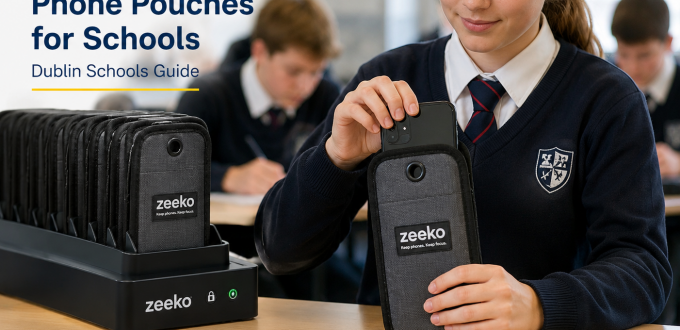
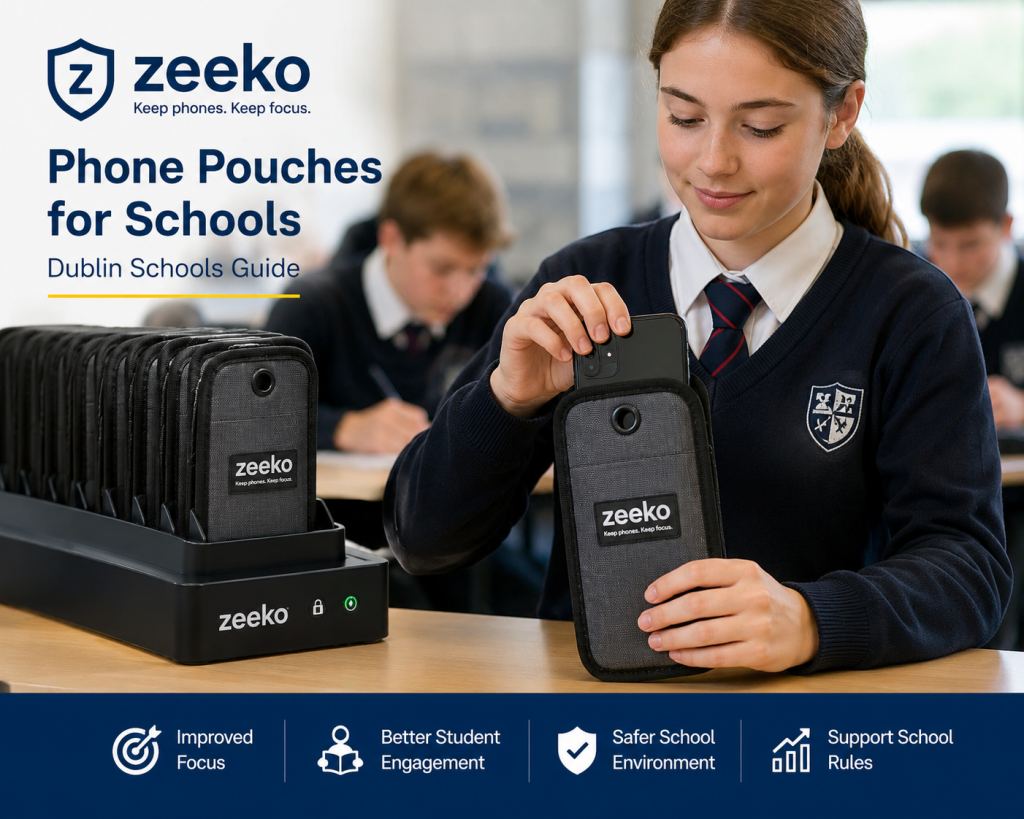
A phone locking pouch is a secure fabric pouch designed to hold a student’s smartphone during school hours. Once the phone is placed inside, the pouch locks magnetically and cannot be opened without a designated unlocking device.
The phone remains with the student at all times, but access is restricted during lessons.
This approach differs from phone confiscation because:
- Students keep physical possession of their phones
- Teachers avoid collecting devices individually
- The process becomes consistent across the school
- Students are less likely to argue about phone restrictions
Many schools view this system as a balanced solution between complete bans and unrestricted access.
How Phone Pouches Work During School Hours
The process is usually simple:
- Students arrive at school with their phones
- Phones are placed into the pouch
- The pouch is locked using a magnetic system
- Students keep the locked pouch in their bags
- Pouches are unlocked at the end of the school day
Some schools may allow unlocking during lunch breaks or specific approved learning activities.
The goal is not to eliminate technology entirely, but to create structured and intentional phone use.
Why Dublin Schools Are Considering Phone Pouch Systems
Supporting School Phone Rules Ireland
Many schools already have mobile phone policies, but enforcement remains challenging.
A structured phone pouch system helps schools apply rules consistently without daily confrontation. Teachers no longer need to repeatedly remind students to put phones away.
This supports broader discussions around school phone rules Ireland and allows schools to implement clearer expectations.
Better Classroom Focus
One of the biggest reasons Dublin schools are exploring phone pouches is improved concentration.
When phones are inaccessible during lessons:
- Students participate more actively
- Classroom discussions improve
- Teachers spend less time managing distractions
- Learning time increases
Several schools internationally have reported noticeable improvements in student attention after implementing phone pouch programs.
Reducing Phone Dependency
Many educators believe students benefit from regular breaks from constant screen use.
A phone-free school environment can encourage:
- More face-to-face interaction
- Better lunchtime socialisation
- Increased participation in sports and activities
- Reduced social media pressure during school hours
For younger students especially, schools are becoming more aware of the long-term impact of excessive smartphone exposure.
Benefits of Classroom Phone Pouch Systems
Improved Student Engagement
Students are more likely to:
- Listen actively
- Join classroom discussions
- Complete tasks on time
- Engage with peers
Without the distraction of notifications and apps, classrooms often become calmer and more productive.
Better Teacher Control
Teachers frequently describe smartphone management as exhausting. Constant monitoring takes attention away from teaching.
A classroom phone pouch system simplifies classroom management by creating clear expectations for everyone.
Benefits for teachers include:
- Fewer disruptions
- Less conflict over phone use
- More teaching time
- Easier policy enforcement
Reduced Cheating During Exams
Mobile phones can create significant academic integrity concerns.
Schools using pouch systems often report reductions in:
- Online answer searching
- Messaging during tests
- Hidden device usage
- AI-assisted cheating during assessments
This is particularly important for exam-focused secondary schools.
Lower Risk of Cyberbullying During School Hours
Cyberbullying incidents often happen during breaks or class time through messaging apps and social media.
Restricted phone access can help reduce:
- Real-time online conflicts
- Secret recordings
- Social media harassment during school hours
- Group chat disruptions
This contributes to a safer school environment overall.
Healthier Social Interaction
Many schools observe positive social changes when phones are limited.
Students are more likely to:
- Talk face-to-face
- Participate in group activities
- Spend time outdoors
- Build stronger friendships
Some schools report noticeably quieter lunchrooms becoming more social after implementing phone restrictions.
How a Phone Pouch System Works
Daily Student Process
Most schools follow a straightforward routine.
Morning Arrival
Students place phones inside their pouches upon arrival.
During the School Day
The locked pouch stays with the student:
- In a bag
- In a locker
- At their desk
End of Day
Students unlock pouches at designated stations before leaving school.
The process typically becomes routine within a few weeks.
Unlocking Procedures
Schools generally use magnetic unlocking bases positioned at exits or supervised areas.
Only authorised staff can unlock pouches during the school day unless an approved situation arises.
Some schools may:
- Allow unlocking for medical reasons
- Permit supervised educational use
- Provide temporary access during emergencies
Emergency Access Handling
One common parent concern involves emergency communication.
Schools usually address this by:
- Keeping emergency contact systems active
- Allowing parents to contact the school office
- Permitting supervised access when necessary
Most schools emphasise that emergency procedures already existed before smartphones became common in schools.
Phones in Irish Schools: Current Policies and Trends
Changing Attitudes Toward Smartphones
The debate around phones in Irish schools has intensified in recent years.
Many schools are moving from relaxed policies toward more structured management approaches due to increasing concerns around:
- Student distraction
- Mental health
- Online safety
- Academic performance
Some schools have introduced full phone bans, while others prefer controlled-use systems.
Government Guidance and National Discussion
Ireland has seen growing public discussion about smartphone use among young people. Parents, educators, and policymakers increasingly support stronger phone management during school hours.
While policies may vary by school, the broader trend shows increasing interest in:
- Reduced smartphone access
- Digital wellbeing education
- Structured technology use
- Student concentration improvement
Differences Between Primary and Secondary Schools
Primary Schools
Primary schools in Ireland often have stricter policies because younger children generally have less educational need for smartphones during school hours.
Some schools prohibit phones entirely.
Secondary Schools
Secondary schools face more complex challenges because older students:
- Travel independently
- Use phones for transport coordination
- Communicate with parents directly
- Depend more heavily on digital communication
This is why many secondary schools prefer a phone pouch system instead of complete confiscation.
Choosing the Right School Phone Pouch Supplier
Durability Matters
Schools need products that can withstand daily use.
When evaluating a school phone pouch supplier, schools should consider:
- Fabric strength
- Stitching quality
- Lock durability
- Long-term wear resistance
Cheap products may fail quickly and increase replacement costs.
Security Features
A reliable pouch should:
- Lock securely
- Resist tampering
- Be difficult to force open
- Function consistently throughout the year
Security reliability is essential for staff confidence and student compliance.
Ease of Use
The best systems are simple for both students and teachers.
Schools should look for:
- Fast locking procedures
- Efficient unlocking stations
- Minimal classroom disruption
- Clear user instructions
Complex systems can create unnecessary administrative problems.
Cost-Effectiveness
Schools should assess:
- Initial purchase costs
- Replacement rates
- Warranty support
- Long-term maintenance
A slightly higher-quality solution may reduce costs over time.
Supplier Support and Training
A strong school phone pouch supplier should also provide:
- Staff training
- Setup guidance
- Policy implementation advice
- Customer support
- Replacement options
Implementation support can significantly improve adoption success.
Common Concerns and Solutions
Parent Concerns About Emergencies
Many parents worry about losing direct communication access with their children.
Schools can address this by explaining:
- Emergency contact procedures remain available
- Students can access phones if necessary
- The school office remains the primary emergency contact point
Clear communication is essential before implementation.
Student Resistance
Some resistance is normal initially.
Schools often succeed by:
- Explaining the reasons clearly
- Highlighting wellbeing benefits
- Applying policies consistently
- Involving student leadership groups
Many schools report that resistance decreases after the first few weeks.
Accessibility and Medical Needs
Schools should create flexible policies for students who require devices for:
- Medical monitoring
- Accessibility tools
- Special educational needs
A balanced approach ensures inclusion while maintaining overall policy effectiveness.
Implementation Tips for Dublin Schools
Start With Clear Communication
Before launching a pouch program:
- Inform parents early
- Explain educational goals
- Share policy documents
- Hold information sessions if needed
Transparency builds trust.
Train Staff Properly
Consistency matters.
Teachers and staff should understand:
- How the system works
- Emergency procedures
- Unlocking protocols
- Student support processes
Introduce the System Gradually
Some schools begin with:
- Specific year groups
- Trial periods
- Limited pilot programs
This allows adjustments before full implementation.
Combine Pouches With Digital Wellbeing Education
Phone pouches work best when combined with conversations about:
- Healthy technology habits
- Online safety
- Social media awareness
- Responsible smartphone use
The goal is education, not punishment.
Monitor and Review Results
Schools should regularly evaluate:
- Classroom behaviour changes
- Student feedback
- Teacher feedback
- Attendance and engagement trends
Continuous review helps improve long-term outcomes.
FAQs About Phone Pouches for Schools
Are phone pouches suitable for all age groups?
Yes, although implementation may vary. Primary schools often use stricter phone restrictions, while secondary schools may benefit more from structured pouch systems.
Can students access phones during emergencies?
Most schools maintain emergency unlocking procedures and allow supervised access when necessary.
Do phone pouch systems completely ban phones?
No. Students usually keep their phones with them but cannot actively use them during school hours.
How long does it take students to adapt?
Many schools report that students adapt within a few weeks once the system becomes part of the daily routine.
Are phone locking pouches expensive?
Costs vary depending on the supplier, product quality, and school size. Durable systems may provide better long-term value.
Can phone pouches reduce cyberbullying?
They can help reduce online conflict and social media misuse during school hours by limiting immediate phone access.
What should schools look for in a school phone pouch supplier?
Schools should consider durability, security, ease of use, supplier support, warranty options, and long-term reliability.
Conclusion
The discussion around phone pouches Dublin schools reflects a wider shift in how schools approach student technology use. As smartphone distractions continue to affect concentration, behaviour, and wellbeing, many schools across Dublin and Ireland are exploring more structured solutions.
A well-designed phone pouch system offers a balanced approach. It allows students to retain possession of their devices while creating more focused, engaging, and socially connected learning environments.
For schools considering stronger school phone rules Ireland, phone pouches can provide:
- Improved classroom focus
- Better student engagement
- Reduced distractions
- Stronger policy consistency
- Healthier school culture
Successful implementation depends on clear communication, staff support, and choosing the right school phone pouch supplier.As more conversations continue around phones in Irish schools, phone pouches are likely to remain an important option for schools seeking practical, student-focused solutions to modern classroom challenges.
Explore Zeeko’s Home Page to discover our mission on the About Us Page, innovative Phone Blocking System, and engaging Phoenix Quest 10 programme. We provide Internet Safety Seminars, the Zeeko Report Card, and the Magical Leaders Choose Country initiative, alongside insights from our Digital Trend Report. Stay connected with us on Facebook and Instagram for updates.