

Introduction
Across Ireland, school leaders are facing a growing challenge: smartphone distraction in the classroom. Mobile phones have become a constant presence in students' lives, bringing benefits such as instant communication and access to information. However, many schools report that unrestricted phone use can negatively affect learning, concentration, social interaction, and overall student wellbeing.
International research from organisations such as UNESCO has highlighted concerns about excessive smartphone use in educational settings, while policymakers across Europe continue to explore practical approaches to reducing classroom distractions. Many Irish schools are now reviewing their school mobile phone policy to create a healthier learning environment and improve student engagement.
This case study examines how one Irish secondary school successfully transformed into a phone free school Ireland model through the implementation of a structured phone management solution. The results included improved classroom behaviour, increased student focus, stronger teacher satisfaction, and a more positive school culture.
Looking to reduce classroom distractions and manage student phone usage effectively?
Explore Zeeko’s Phone Pouch Solution designed specifically for schools.
Quick Answers: Phone-Free Schools in Ireland
What is a phone free school in Ireland?
A phone free school in Ireland is a school that restricts student access to smartphones during the school day. Students keep their devices secured in designated storage systems or phone pouches, helping create a distraction-free learning environment while still allowing phones to be returned at the end of the day.
Why are Irish schools becoming phone free?
Irish schools are increasingly adopting phone-free policies to improve concentration, reduce classroom disruptions, support student wellbeing, minimise cyberbullying risks, and encourage face-to-face social interaction. Many school leaders believe structured phone management creates a more focused and productive educational environment.
How do schools stop students using phones during class?
Schools use several approaches, including phone pouches, secure storage systems, classroom lockers, confiscation policies, and clear school-wide rules. Structured systems tend to be most effective because they reduce temptation while providing consistent enforcement across all year groups.
Do phone-free schools improve concentration?
Many schools report improved student concentration after implementing phone-free policies. Removing access to smartphones during lessons helps reduce interruptions, supports deeper learning, increases classroom participation, and encourages students to remain engaged with educational activities.
What phone management systems do Irish schools use?
Irish schools use a range of phone management systems, including lockable phone pouches, secure storage units, and supervised collection procedures. Increasingly, schools favour pouch-based solutions because they balance student responsibility with effective phone restriction.
How effective are phone pouches in schools?
Phone pouches are highly effective when implemented as part of a whole-school policy. They remove the immediate temptation to access smartphones while allowing students to keep possession of their devices, creating a practical and non-confrontational approach to phone management.
The Challenge
A Growing Problem
St. Brigid's Community College (name changed for privacy), a fictionalised but realistic Irish secondary school, had experienced a steady increase in smartphone-related disruptions over several years.
Teachers reported:
- Students checking notifications during lessons
- Increased social media distractions
- Reduced attention spans
- Difficulties maintaining classroom management
- Growing dependency on smartphones during breaks
The school's leadership team also identified several broader concerns.
Constant Classroom Interruptions
Even brief notifications disrupted lesson flow. Teachers frequently had to pause instruction to address students using phones under desks or during independent work periods.
Social Media Distractions
Platforms such as TikTok, Instagram, Snapchat, and messaging apps competed directly with classroom learning. Students often struggled to remain focused for extended periods.
Reduced Academic Engagement
Teachers observed that students were less likely to participate in discussions and collaborative activities when phones remained accessible throughout the school day.
Teacher Frustration
Enforcing phone rules varied from classroom to classroom. Some teachers were strict, while others preferred a more flexible approach, leading to inconsistent expectations.
Parent Concerns
Parents increasingly contacted the school regarding excessive screen time, online conflicts, and reduced concentration at home.
Cyberbullying and Image-Sharing Risks
School leadership also noted concerns regarding inappropriate photography, unauthorised image sharing, and digital conflicts that often originated during school hours.
About the School
St. Brigid's Community College is a co-educational secondary school located in Ireland with approximately 850 students.
Existing Phone Policy
Before the initiative, the school operated a traditional policy:
- Phones should remain off during class.
- Students could use phones during breaks.
- Teachers enforced rules individually.
- Repeated offences resulted in confiscation.
Challenges Before Implementation
Despite clear rules, enforcement proved difficult.
A staff survey revealed:
- 78% of teachers experienced daily phone-related interruptions.
- 71% believed phone use negatively affected learning.
- 64% reported spending valuable teaching time managing phone behaviour.
School leaders concluded that policy alone was not solving the problem.
The Search for a Solution
The leadership team explored several options.
Confiscation Policies
Confiscation created conflict between staff and students. Teachers often felt uncomfortable acting as "phone police."
Honour-Based Rules
Students were expected to self-regulate. While effective for some, many students struggled to resist constant notifications and social media temptations.
Classroom Storage Boxes
Several teachers trialled storage boxes at the front of classrooms.
Challenges included:
- Inconsistent use
- Lost learning time
- Concerns about device security
- Lack of whole-school adoption
Increased Teacher Monitoring
Monitoring alone placed additional pressure on teachers and failed to address the underlying temptation of having phones constantly available.
Exploring a Structured Solution
Following consultations with parents, teachers, students, and school board members, the leadership team concluded that a consistent school-wide system would be necessary.
Their goal was not punishment.
Their goal was improved student focus in school.
Implementation of the Phone-Free Policy
The school adopted a phased implementation approach.
Step 1: Stakeholder Consultation
The leadership team organised meetings with:
- Teachers
- Parents
- Student representatives
- School board members
Feedback highlighted strong support for reducing distractions while maintaining reasonable access to devices.
Step 2: Parent Communication
Parents received:
- Information sessions
- Frequently asked questions
- Implementation timelines
- Emergency contact procedures
Transparency helped build trust and support.
Step 3: Student Onboarding
Students attended workshops covering:
- Digital wellbeing
- Responsible technology use
- Academic focus
- Benefits of phone-free education
The emphasis remained positive rather than punitive.
Step 4: Teacher Training
Teachers received guidance on:
- Consistent implementation
- Student communication
- Escalation procedures
- Digital wellbeing principles
This ensured all staff applied the policy uniformly.
Step 5: Deployment of the Zeeko Phone Blocking System
The school selected the Zeeko Phone Blocking System as its preferred solution.
The system aligned with the school's goals because it provided consistency, simplicity, and student accountability.
What Is the Zeeko Phone Blocking System?
The Zeeko Phone Blocking System is a structured phone management solution designed specifically for schools.
Lockable Phone Pouches
Students place their smartphones into secure locking pouches at the beginning of the school day.
The devices remain with students but cannot be accessed during lessons.
Student Responsibility Model
Unlike confiscation, students retain possession of their phones throughout the day.
This promotes responsibility and ownership.
Secure Storage During School Hours
The pouch remains locked until authorised unlocking stations are used at the end of the day.
Non-Confrontational Enforcement
Teachers no longer need to debate phone use with students.
The system creates clear expectations and removes ambiguity.
Easy Daily Use
The process takes only a few seconds each morning and quickly becomes part of the school's daily routine.
Results After Implementation
After six months, the school conducted surveys and classroom observations to evaluate the impact.
Student Focus
Teachers reported significant improvements in concentration.
Key observations included:
- Increased participation
- Better note-taking
- Longer attention spans
- Improved classroom discussions
Many students acknowledged they were less distracted without immediate phone access.
Classroom Behaviour
Staff observed:
- Fewer interruptions
- Reduced off-task behaviour
- More productive learning environments
- Better peer interaction
Students spent more break times engaging socially rather than scrolling through screens.
Academic Outcomes
Although academic results are influenced by many factors, teachers reported:
- Improved homework completion
- Better assignment quality
- Greater lesson engagement
- Increased willingness to participate
Teacher Feedback
One teacher commented:
"For the first time in years, I can teach an entire lesson without repeatedly reminding students to put their phones away."
Another added:
"Classroom discussions are more dynamic because students are genuinely present and engaged."
Parent Feedback
Parent surveys produced positive responses.
One parent shared:
"My son talks more about what happened at school instead of what happened online."
Another stated:
"The phone pouch system reduced a lot of stress around screen time and social media."
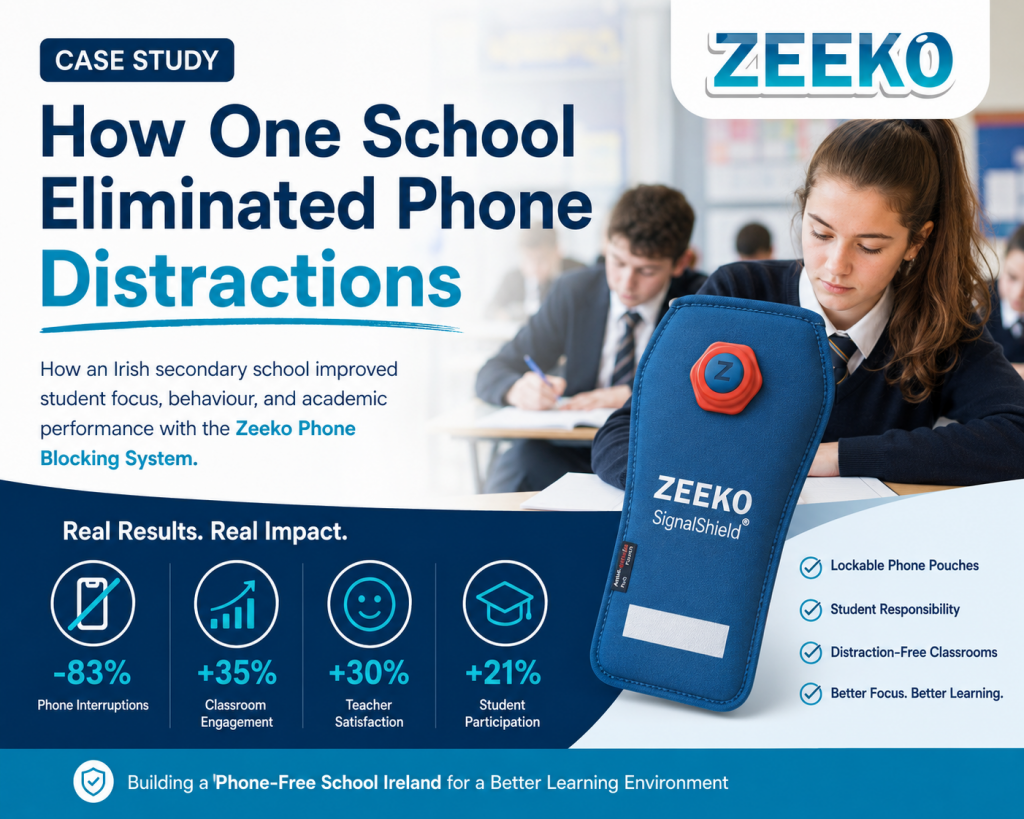
Key Metrics Comparison
| Metric | Before | After |
| Phone Interruptions | 18 per day average | 3 per day average |
| Classroom Engagement | 62% positive rating | 84% positive rating |
| Teacher Satisfaction | 58% positive rating | 88% positive rating |
| Student Participation | 61% active participation | 82% active participation |
Why the Program Worked
Several factors contributed to success.
Consistency
Every student followed the same rules.
Consistency eliminated confusion and reduced enforcement challenges.
Clear Expectations
Students understood exactly what was expected from day one.
Whole-School Adoption
Because the entire school participated, there were no mixed messages.
Student Accountability
Students retained ownership of their devices, encouraging responsibility.
Reduced Temptation
The most important factor was simple:
Students could no longer access phones impulsively throughout the day.
Featured Snippet Answer Boxes
Question:
What is a phone free school?
Answer: A phone free school restricts student access to smartphones during the school day to improve focus, reduce distractions, and support learning.
Question:
Why do schools use phone pouches?
Answer: Phone pouches help schools reduce smartphone distractions while allowing students to keep possession of their devices securely.
Question:
Do phone-free classrooms improve learning?
Answer: Many schools report improved concentration, participation, and classroom engagement after implementing phone-free policies.
Question:
How do phone blocking systems work?
Answer: Students place phones inside secure locking pouches that remain inaccessible until authorised unlocking stations are used.
Question:
Are phone pouches safe?
Answer: Modern phone pouches are designed to securely hold devices while preventing unauthorised access during school hours.
Question:
Why are Irish schools restricting phones?
Answer: Schools aim to improve student focus, reduce distractions, enhance wellbeing, and create healthier learning environments.
Question:
Can parents contact students during the day?
Answer: Parents can contact the school office, which can relay urgent messages to students when necessary.
Question:
What are the benefits of phone-free education?
Answer: Benefits include better concentration, improved social interaction, stronger engagement, and fewer classroom disruptions.
Lessons for Other Irish Schools
For Primary Schools
- Focus on digital wellbeing education.
- Engage parents early.
- Introduce expectations gradually.
For Secondary Schools
- Implement consistent policies.
- Use structured phone management systems.
- Provide student education around responsible technology use.
For School Administrators
- Build stakeholder support.
- Measure outcomes.
- Communicate clearly.
- Prioritise long-term culture change over short-term enforcement.
Frequently Asked Questions
What is a phone free school Ireland?
A phone free school Ireland model restricts student access to smartphones during school hours to improve concentration, behaviour, and academic engagement.
Are phone pouches allowed in Irish schools?
Yes. Schools may adopt phone pouch systems as part of their school phone policy Ireland, provided implementation follows school governance procedures.
How do schools enforce phone-free policies?
Schools typically combine clear rules, staff training, parent communication, and structured phone management systems.
Do students benefit from phone-free classrooms?
Many schools report improved concentration, stronger participation, and healthier peer interaction.
What is the best phone management system for schools?
The best solution is one that provides consistent school-wide implementation while maintaining student responsibility and ease of use.
How does a phone blocking system work?
Students place phones inside lockable pouches that remain inaccessible during the school day.
Can parents contact students during school hours?
Yes. Schools maintain communication channels through administrative offices for urgent matters.
Are phone pouches tamper-proof?
Most school-grade phone pouches are designed with security features that discourage unauthorised access during school hours.
How much do phone management systems cost?
Costs vary depending on school size, implementation requirements, and selected technology solutions.
Why are more Irish schools restricting smartphones?
Schools are seeking to improve student focus, reduce distractions, enhance wellbeing, and support positive learning outcomes.
Conclusion
This case study demonstrates how a structured approach helped transform a secondary school into a successful phone free school Ireland model.
Rather than relying on confiscation or inconsistent enforcement, the school adopted a clear, whole-school strategy centred on student responsibility and practical phone management. The results included fewer classroom interruptions, stronger student engagement, improved teacher satisfaction, and a healthier learning environment.
As more Irish schools seek solutions to smartphone distractions, structured systems such as the Zeeko Phone Blocking System provide a practical pathway towards sustainable change.
For school leaders, boards, and policymakers, the lesson is clear: effective phone management is not about restricting technology—it is about creating the conditions where students can learn, connect, and thrive without constant digital interruption.
Explore Zeeko’s Home Page to discover our mission on the About Us Page, innovative Phone Blocking System, and engaging Phoenix Quest 10 programme. We provide Internet Safety Seminars, the Zeeko Report Card, and the Magical Leaders Choose Country initiative, alongside insights from our Digital Trend Report. Stay connected with us on Facebook and Instagram for updates.