

WHAT IS “STOP, BLOCK, TELL?”
Everyone knows the Safe Cross Code right?
It’s the shorthand for the rules for crossing the road, and it’s a great way to create not just an awareness of danger for young children, but it’s also great shorthand for a set of steps to safety. It’s got a catchy tune and all, so that young children – and their minders – can learn the safe way to cross a busy street. Essentially the safety code for crossing the road is to stop, look and listen before walking straight across the road. Stop. Look. Listen. Walk. Keep Watching.
As a parent, none of us would let our young primary school child cross the road on their own without supervision or without teaching them the Safe Cross Code. Yet, a busy route that has a lot more dangers in it than a busy road – the Internet – is being navigated all the time by young unsupervised children without any rules being taught beforehand. Much of the time, minders don’t realize their young charges are out there navigating this new highway, often on roads designated only for adults.
The Internet can be a terrific resource for young children, but it can also hold its dangers, and we at Zeeko want to help parents – and children – to learn their own Safe Cross Code for the Internet.
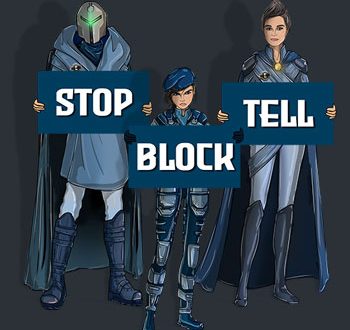
We call it STOP, BLOCK, TELL.
This is what we show primary school children at our seminars, and what we advise parents and minders to do when supervising children using the Internet. These are the rules that can be used at home as well. We even have hand movements to go with the rules, that our young learners enjoy using when we give seminars in primary schools on Internet Safety for children. It’s a code for helping children who encounter inappropriate content or have experiences that make them feel bothered or upset. These include cyberbullying, but also unintended comments or photographs.
STOP
The first step is to stop the content coming into your phone or computer. If a child feels something is not right – even if they are not sure why – the first step is always to stop it. That means not replying to a post, not sharing a post, comment or photo. It also means not writing something like “go away” or “leave me alone”.
BLOCK
Every child who is using Snapchat, Facebook (yes we know it’s for over 13s but that doesn’t stop primary school children using it), or Instagram should know how to block a user who is bothering them. It’s an easy thing to do, and a child who knows how to do this is being empowered to take care of themselves, an important part of the Zeeko approach to internet security. Blocking a user means they can no longer contact you, and there is also a facility to report a user. We believe that reporting should be a last resort, such as persistent unsolicited contact from a stranger. Our Zeeko guide to Internet Security includes a section showing you how to block users if you wish to.
TELL
The third step we teach a child is to tell someone if you are worried or upset about anything you have seen on the Internet, including social media. That person can be a member of your family, but ideally an adult or trusted person who will take action for you. This might be a website with inappropriate material, or – more likely – a comment or photograph on social media that has upset the child. So showing someone not only means you are sharing the worry it might have caused you, it also means someone can reassure you and protect you. Being a victim of cyberbullying can sometimes mean you are afraid to speak out; but telling someone is the first step to solving the problem. We encourage adults to help children to discuss with their child how he or she feels about a negative online experience.
TO SUMMARISE, we believe children can use the Internet safely, but do need to be taught about the dangers, the boundaries and what do to if they run into danger.
The STOP, BLOCK, TELL code is an effective way of helping children to learn how to take care when they are on the web, including social media.
As smartphones and free Wi-Fi become the norm in our day to day lives, our young children need to know the rules that help keep them safe on the internet.
WANT TO KNOW MORE ABOUT OUR SEMINARS?
Give us a call at 01-5312612
Or email us at louise@zeeko.ie
Frequently Asked Questions
1. What is “Stop, Block, Tell”?
Stop, Block, Tell is a simple internet safety code designed to help children deal with uncomfortable or unsafe online experiences. It teaches them three easy steps to protect themselves when something online makes them feel worried, upset, or unsafe.
2. Why is Stop, Block, Tell important for children?
Children often use the internet without fully understanding its risks. Stop, Block, Tell gives them clear rules—similar to road safety rules—so they know what to do if they encounter cyberbullying, inappropriate content, or unwanted contact online.
3. How is Stop, Block, Tell similar to road safety rules?
Just like the Safe Cross Code teaches children how to cross roads safely, stop, block, tell teaches children how to navigate the internet safely. Both use simple steps to build awareness, confidence, and safer behaviour.
4. What does “Stop” mean in Stop, Block, Tell?
The Stop step means not responding to upsetting content. Children are taught not to reply, comment, share, or react in any way—even to say “go away”—as responding can make the situation worse.
5. Why shouldn’t children reply to upsetting messages online?
Replying can encourage further contact or escalation. The stop step helps prevent the situation from growing and gives children time to think and seek help instead of reacting emotionally.
6. What does “Block” mean in Stop, Block, Tell?
Block means using app or platform tools to stop someone from contacting you. Blocking prevents messages, comments, or interactions from a person who is bothering or upsetting the child.
7. Should children know how to block users on social media and apps?
Yes. Teaching children how to block users empowers them to take control of their online space. Knowing how to block is an important part of learning digital responsibility and self-protection.
8. When should reporting be used instead of blocking?
Reporting should be used when there is persistent unwanted contact, especially from strangers. Blocking is often enough, but reporting helps platforms take action in more serious cases.
9. Who should children “Tell” if something upsets them online?
Children should tell a trusted adult, such as:
-
A parent or guardian
-
A teacher
-
A school staff member
Telling helps adults reassure the child and take action to keep them safe.
10. Why is “Tell” the most important step in Stop, Block, Tell?
Telling ensures children are not dealing with problems alone. It allows adults to provide support, reassurance, and protection—especially in cases of cyberbullying where children may feel afraid to speak up.
11. Is Stop, Block, Tell only for cyberbullying?
No. Stop, block, tell can be used for:
-
Cyberbullying
-
Inappropriate comments or images
-
Unwanted messages
-
Anything online that makes a child feel uncomfortable or confused
12. Can Stop, Block, Tell be used at home and in school?
Yes. Stop, Block, Tell works both at home and in schools. Parents, teachers, and carers can reinforce the same safety message to help children build consistent and safe online habits.
13. At what age should children learn Stop, Block, Tell?
Children should learn stop, block, tell as soon as they begin using the internet or smart devices. Younger children benefit from simple rules, hand movements, and repetition to remember the steps.
14. Does Stop, Block, Tell mean children should avoid the internet?
No. The goal of stop, block, tell is not to scare children away from the internet, but to help them use it safely, confidently, and responsibly with the right guidance.
Explore Zeeko’s Home Page to discover our mission on the About Us Page, innovative Phone Blocking System, and engaging Phoenix Quest 10 programme. We provide Internet Safety Seminars, the Zeeko Report Card, and the Magical Leaders Choose Country initiative, alongside insights from our Digital Trend Report. Stay connected with us on Facebook and Instagram for updates.
No Comments Yet