


In schools around the world, one question keeps coming up: what should we do about smartphones in the classroom? Total bans are hard to enforce, while “do not use your phone” rules often fail in practice. That’s why many schools are turning to a middle-ground solution: the phone in a bag policy.
Under this approach, students can bring their phones to school but must keep them in a bag, backpack, or special phone pouches during the school day. It sounds simple—but does it really work? Does it actually cut down on distractions, or does it just move the problem out of sight?
In this blog, we’ll explore how phone in a bag policy work, the different types of bag phones and pouches schools use, and what really makes these school phone rules effective.
What is a “Phone in a Bag” Policy?
A phone in a bag policy is a set of school phone rules that allows students to bring their devices to school but strictly limits how and when they can use them. Typically, this means:
- Phones must be kept in a bag, backpack, or designated pouch during classes.
- Devices must be on silent or switched off.
- Phones can only be used at specific times, such as before and after school, or sometimes during lunch.
- If a phone is seen or heard in class, teachers may confiscate it according to school policy.
In some schools, “phone in a bag” literally means “phone in your backpack.” In others, it refers to more structured systems involving phone pouches that students use every day.
Types of Phone Pouches and Bag Systems Schools Use
The phrase “phone in a bag” can cover several different approaches. Understanding the options helps schools choose what works best for their context.
1. Simple “Phone in Your Backpack” Rule
This is the most basic version of the policy: Students keep their phones in their regular school bags. The phone must not leave the bag during lessons. If a teacher sees or hears a phone, they can take it until the end of class or day.
Pros
- No extra cost for special bags or pouches.
- Easy to explain and implement.
- Allows students to carry phones for before/after school safety.
Cons
- Easy for students to ignore and keep phones in pockets instead.
- Teachers must constantly monitor and enforce.
- Notifications can still tempt students, even if the phone is inside the bag.
2. Lockable Phone Pouches
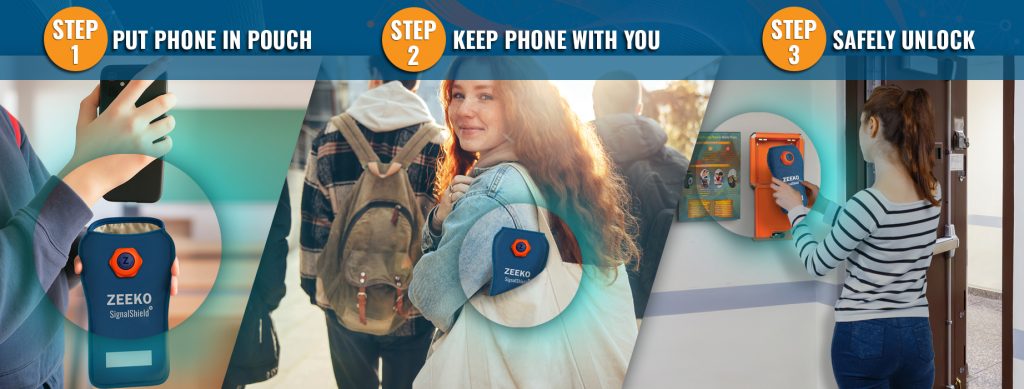
Many schools now use lockable phone pouches (often magnetic) that act like personal phone lockers students carry with them. How they work?At the start of the day, students place their phone in the pouch.
The pouch is locked using a special device. Students keep the pouch but cannot open it until it is unlocked at the end of the day or in designated zones.
Pros
- Strongly limits access to the phone during the school day.
- Reduces arguments between teachers and students about usage.
- Creates a near phone-free classroom environment.
Cons
- Costly for schools to purchase and maintain.
- Requires time and staff to lock/unlock pouches daily.
- Some parents and students worry about access in emergencies.
3. Signal-Blocking or Faraday Bags
Some schools use Faraday bags or signal-blocking bags: Students put their phones inside the bag, which blocks calls, texts, and data. The phone can still be removed and used quickly if genuinely needed.
Pros
- Prevents notifications and online access during class.
- Phones remain physically accessible in case of emergencies.
- Often seen as a balance between safety and focus.
Cons
- Still requires clear rules and monitoring.
- Students can open the bag unless there are consequences.
- Additional cost compared to a simple backpack rule.
Why are schools turning to phone pouches Policy?
There are several reasons why school phone rules are tightening and why bag phones and pouches are gaining popularity.
Reducing Classroom Distractions
Smartphones are designed to grab attention. Notifications, social media, and games can quickly pull students away from lessons. When phones are kept in bags or pouches:
- Students are less likely to check messages mid-lesson.
- Teachers spend less time policing screens.
- Focus and participation often improve.
Limiting Cyberbullying and Social Drama in Class
A lot of bullying and conflict now happens through:
- Messaging apps
- Social media
- Group chats
Keeping phones out of reach during lessons helps reduce:
- In-the-moment reactions to hurtful messages.
- Secret photos or videos of classmates and teachers.
- Distractions from ongoing online arguments.
Protecting Academic Integrity
Phones make it easier to:
- Look up answers during tests.
- Share pictures of test papers.
- Use AI tools or websites to solve assignments in real time.
Phone-in-a-bag rules, especially with pouches, limit these opportunities for cheating.
Supporting Teacher Wellbeing
Constant battles over phones can be exhausting. Clear, school-wide policies:
- Give teachers consistent backing.
- Reduce arguments and negotiations about “just one quick text”.
- Help create a calmer classroom environment.
Does hone pouches Really Work?
The honest answer is: it depends on how it’s done. A phone-in-a-bag system can be highly effective, but only when supported by clear rules, consistent enforcement, and community buy-in.
When phone pouches Policy Work Best?
These policies tend to succeed when:
- Expectations are clear: everyone knows when, where, and how phones can be used.
- Consequences are consistent: if a phone comes out, the same steps follow every time.
- The rule is school-wide: all teachers and staff apply the policy, not just a few.
- Parents are informed and supportive: they understand why the policy exists and don’t encourage students to break it.
- Students see benefits: calmer classrooms, fewer distractions, and more time to actually talk to friends.
Schools that use lockable phone pouches or strict bag rules often report:
- Fewer interruptions during learning.
- Less visible phone use throughout the day.
- More social interaction during breaks instead of constant scrolling.
When It Fails to Make a Difference?
On the other hand, a phone-in-a-bag rule may not work if:
- Students can keep phones in pockets and teachers rarely check.
- The consequences are unclear or rarely applied.
- Some teachers enforce the rule while others ignore it.
- The policy is introduced suddenly without explanation, causing resistance.
In these cases, the policy exists on paper, but student behaviour doesn’t change much. The rule becomes something to work around rather than a genuine shift in school culture.
Pros and Cons of Phone-in-a-Bag Approaches
Here’s a quick summary you can use in your thinking about school phone rules:
| Approach | Main Strength | Main Weakness |
|---|---|---|
| Phone in backpack | Simple, low cost | Easy to ignore, hard to enforce strictly |
| Lockable phone pouches | Very effective at limiting access | Costly, needs daily logistics |
| Signal-blocking “bag phones” | Balances access and distraction control | Still needs strong rules and monitoring |
Balancing Safety and Focus: The Emergency Question
One of the biggest concerns around strict school phone rules is safety. Parents often feel more secure when their child has a phone for:
- Emergencies
- Travel to and from school
- Quick communication about changes in schedule
At the same time, schools argue that:
- In real emergencies, students should follow instructions from staff, not be distracted by phones.
- Phones can sometimes spread panic, rumours, or misinformation faster.
Phone-in-a-bag solutions aim to balance this:
- Phones are present on campus for before and after school safety.
- During class, phones are out of sight and ideally out of mind.
- Systems like Faraday bags keep phones nearby but prevent constant notification distractions.
The key is a policy that clearly explains:
- When students can access their phones.
- What happens in different types of emergencies.
- How the school will communicate with parents in urgent situations.
How Schools Can Make Phone in a Bag Policies Work?
If a school decides to adopt a phone-in-a-bag approach, success depends less on the bag itself and more on implementation.
1. Set Clear, Simple Rules
Avoid complicated exceptions and special cases. For example:
- “Phones must stay in bags or pouches from first bell to last bell.”
- “Phones can only be used in designated areas after school.”
The clearer the rule, the easier it is to follow and enforce.
2. Communicate with Parents and Students
Before launching the policy:
- Explain why it’s being introduced (focus, wellbeing, bullying, cheating, etc.).
- Share what will change day-to-day.
- Describe how emergencies will be handled.
When families understand the purpose, they are more likely to support the change.
3. Support Teachers with a Clear Process
Teachers need:
- Step-by-step guidance on what to do if they see a phone.
- A system for recording repeated issues.
- Backing from school leadership when enforcing rules.
This makes it easier for them to be consistent without feeling like the “phone police” all day.
4. Offer Positive Alternatives
If students suddenly can’t use their phones during breaks, they need something else to do:
- Clubs and activities
- Sports
- Reading corners
- Spaces for music, art, or games
These options make the policy feel less like punishment and more like a shift towards healthier habits.
5. Review and Adjust
After a term or year:
- Gather feedback from teachers, students, and parents.
- Look at any changes in behaviour issues, focus, or school climate.
- Tweak the policy if some parts are unrealistic or confusing.
Policies that evolve with real feedback are more likely to last.
Is Phone in a Bag the Answer?
So, does a phone in a bag policy really work? It can—when it’s:
- Thoughtfully designed
- Clearly explained
- Fairly and consistently enforced
- Supported by both school and home
A phone pouch or bag is just a tool. On its own, it won’t magically fix distraction, cyberbullying, or cheating. But as part of a wider strategy for healthy, focused learning, it can make a real difference. For schools, the key is to see phone-in-a-bag policies not as a war on technology, but as a way to protect attention, relationships, and wellbeing in a world where smartphones are always within reach.
FAQs
Are phone pouches better than a simple backpack rule?
Phone pouches usually work better at preventing sneaky phone use because they physically limit access. A backpack rule can help, but it relies more on student self-control and teacher supervision.
Do students still bring phones if pouches are used?
Yes. Most policies still allow students to bring phones; they just have to be stored in pouches or bags during the day. This keeps the balance between safety and reduced distraction.
What about emergencies if phones are in pouches or bags?
Schools with strict phone rules usually have clear emergency procedures. Staff communication systems, alarms, and announcements are prioritized, and in some systems, phones can be accessed quickly if genuinely needed.
Will a phone-in-a-bag policy stop cyberbullying?
It won’t eliminate cyberbullying completely, since much of it happens outside school hours. However, it can reduce in-class incidents and give students a break from constant online pressure during the school day.
Is it better to ban phones completely instead of using bags or pouches?
A full ban can work in some schools but is harder to enforce and often unpopular with parents. Phone-in-a-bag or pouch policies often provide a more realistic compromise that schools can maintain long term.
Explore Zeeko’s Home Page to discover our mission on the About Us Page, innovative Phone Blocking System, and engaging Phoenix Quest 10 programme. We provide Internet Safety Seminars, the Zeeko Report Card, and the Magical Leaders Choose Country initiative, alongside insights from our Digital Trend Report. Stay connected with us on Facebook and Instagram for updates.